
Ceiling and Wall Leaks in Austell, GA
A brown patch that keeps spreading, paint that blisters, a drip into a bucket or a bulge you would rather not touch: ceiling and wall leaks in Austell, Mableton and Clarkdale start somewhere above or inside. Call (678) 737-4866 and tell what the stain looks like, which room sits over it and whether it grows after rain or after someone showers.
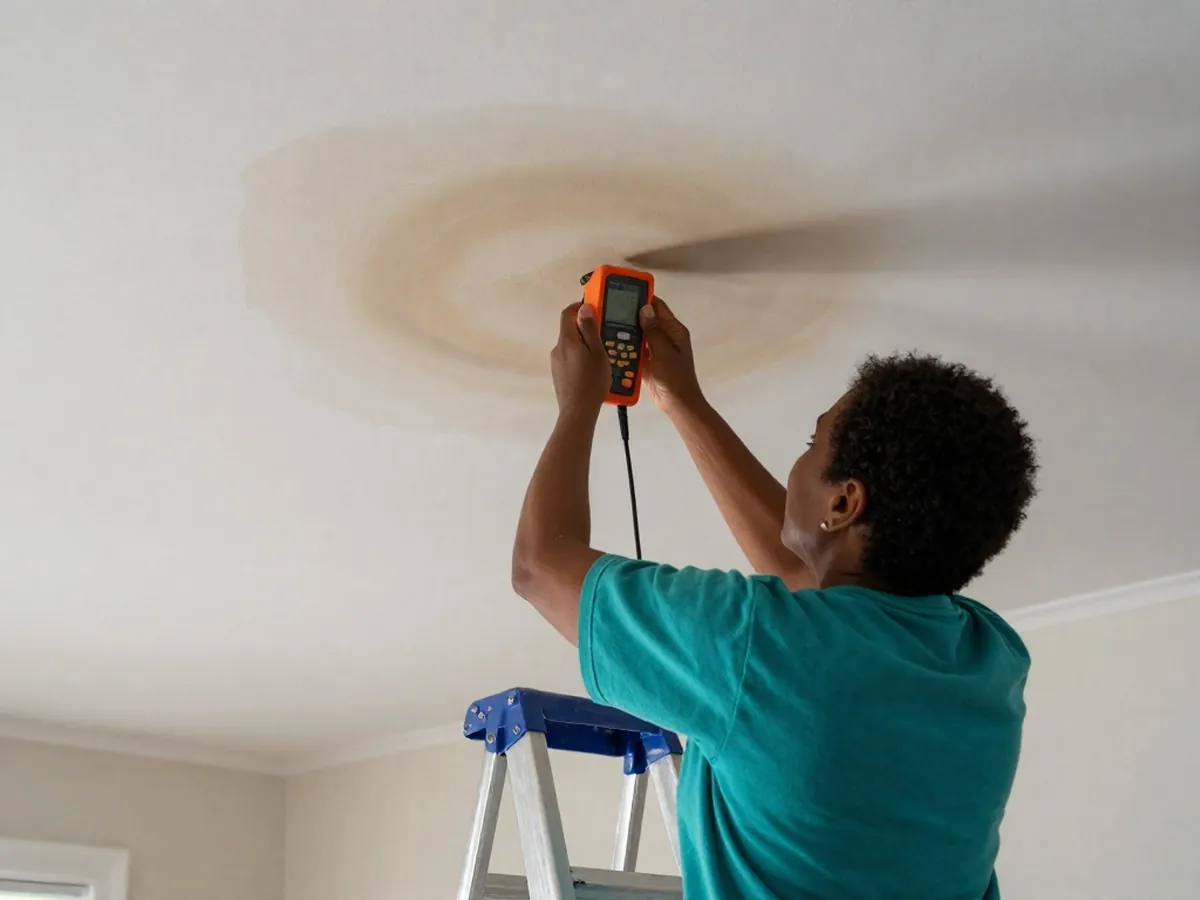
Stains, drips and sags overhead in Austell homes
- A brown or yellow patch on the ceiling that keeps widening
- Paint bubbling or peeling in a patch on a wall
- A slow drip, or a drip only after rain
- A ceiling that droops or bulges in the middle
- A drywall seam that opens or cracks near the stain
Moves that backfire
Four things people do to a bulging ceiling
- 01
Poking a hole to let it drain. According to the Red Cross, hitting the middle of a damaged spot may send the entire ceiling down.
- 02
Painting over the stain while the source is still unknown. The mark returns with the next rain or the next shower.
- 03
Standing under it to take the picture. Shoot from the doorway or from the side, and zoom in.
- 04
Writing off a stain that dried. Dry is not the same as finished: a ceiling that stays wet past a day can grow mold, per the EPA, and a repeat leak soaks it again.
Where it tends to start
- A roof leak finding its way through insulation to the drywall
- A supply line or drain in the floor above
- A tub, shower or toilet seal letting water past
- A water heater or washer on the floor above
- Condensation on an air handler or duct in the attic
Back away and get help if
- Sagging or bulging ceiling: stay out from underneath and leave it unpoked; the Red Cross says hitting the middle may drop the whole ceiling.
- A light fixture or ceiling fan with water running through it: do not flip the switch. Move to another room and tell 911 or the electric company.
- Gas smell near the water heater or furnace, whether above or below the stain: out of the house first; the gas utility or 911 can be reached from the street.
- Brown, foul-smelling water dripping from above may be coming from a drain line: children and pets stay back, and nobody touches it.
How a job tends to run
From the first stain to a closed ceiling
- Spotting it
Note the date, photograph the stain with something for scale, and stay out from under it if it sags.
- Tracing it
The source is found: the roof above, a bath or kitchen overhead, an air handler, or a pipe in the wall.
- Opening up
Wet drywall is cut back to dry material and the insulation above it is checked; the Red Cross notes a sagging ceiling will likely need replacing.
- Drying
Fans and dehumidifiers run while meter readings fall; the EPA's cutoff for refinishing is a reading at or below 15 percent.
- Closing
New drywall, texture and paint go on last, after the source has been repaired.
Questions for the contractor
Five questions before anyone cuts the drywall
- How will the source be found before the ceiling is opened?
- How much of the ceiling is likely to come down, and what is behind it?
- Who handles the roof or pipe repair, and who handles the drying?
- How will the insulation above the stain be checked?
- What will the room look like when the contractor leaves, and who finishes it?
Looks from dry ground
These are looks and sniffs from dry ground. Anything calling for a ladder, a tool or a step onto a wet floor belongs to the contractor.
- Note when it drips: during rain, after a shower, or all the time. The pattern points to the roof, a bathroom or a pipe.
- Look at the room above the stain for a wet floor, a tub, a washer or a toilet.
- From the attic hatch, sweep a flashlight across the roof boards and the insulation. Photograph anything dark or damp, and stay on the ladder or the hatch rim rather than stepping onto joists.
- Photograph the stain beside a coin or a tape measure and date it.
What changes the size of the job
Why a small stain can mean a large ceiling job
- What caused it.
- A roof leak, a pipe above and a condensation line leave different amounts of wet material behind.
- How far the water traveled.
- Water moves along joists and pipes, so the stain is rarely the edge of the wet area.
- What sits above.
- Insulation and floors hold water, and some of it may need to come out.
- The finish.
- Textured ceilings and tall rooms add work to the repair at the end.
Local lines to know
- Across the Atlanta normals, October is the lightest month at 3.28 inches and July the heaviest at 4.75, so a roof leak has no dry season to hide in. UGA Extension's maintenance checklist begins with the roof and attic when it lists leaks and stains.
- About a fifth of Austell's homes date from before 1980 and roughly a third from the 2000s, in the Census count for 2020 to 2024, which puts roof and plumbing ages across a wide range.
Straight answers
How urgent is a ceiling stain, from 1 to 10?
Eight to ten if the ceiling droops or water reaches a light fixture: stay clear and send the call to 911 or the utility instead. Five to seven for a stain that is damp and widening. One to three for an old, dry mark that has stopped changing; photograph it and keep an eye on it.
Is it safe to pierce a bulging ceiling?
The Red Cross describes a way to relieve a bulge, yet cautions that a blow to the center may drop the entire ceiling, which will probably need replacing anyway. Wet drywall coming down on a person is the danger, so the careful course is leaving it to a contractor.
Can a stain just be painted over?
Paint hides a stain, not dampness. The EPA's advice is to repair the leak and dry everything completely, and it says mold can start in drywall that stays wet beyond a day.
Which comes first, the roof or the pipes?
The pattern tells you: leaks that arrive with rain point toward the roof, and those that follow a shower or a washer cycle point toward plumbing above. The ceiling-stain tracer walks through it.
Is a stain in Mableton or Clarkdale covered here?
Yes, Mableton's page and Clarkdale's page sit alongside Austell's. Call (678) 737-4866, then describe the stain and whatever sits in the room above it.
Keep the street address, the wet room and a few phone photos close by. Then call (678) 737-4866 and describe where the water came from and what it touched. Tenants, tell the owner or manager as well.
Call (678) 737-4866A word on paperwork
When a section of ceiling comes down for good
Neither Austell's nor Mableton's pages opened for this site mention drywall replacement by name. The paperwork page shows what they do say about repair work.